TL;DR: Water damage restoration in Jacksonville typically runs $1,500 to $5,000 for a single-room mitigation job and $4,000 to $12,000 or more when Category 3 water or multiple rooms are involved. Extraction and drying alone usually cost $1,200 to $4,500, separate from the drywall, ceiling and flooring rebuild, which adds $800 to $45,000 depending on scope. Florida’s humidity extends drying time, and homeowners insurance usually covers sudden losses like a burst pipe but excludes flood and most sewer backups.
If a supply line let go under a sink in Orange Park last night, or wind-driven rain found its way through a soffit in Ponte Vedra Beach, you’re standing in a wet room trying to figure out what this is going to cost before you even call anyone. The honest answer is: it depends on how much water, how contaminated it is, and how far it traveled under your slab. Below are real, typical price ranges for Jacksonville-area jobs, split into mitigation (drying out the structure) and rebuild (putting it back together), plus how Florida insurance usually treats each piece.
How Much Does Water Damage Restoration Cost in Jacksonville?
Most Jacksonville homeowners pay between $1,500 and $5,000 for a contained, single-room water loss, and $4,000 to $12,000 or more for a multi-room or Category 3 loss that needs content removal and antimicrobial treatment. Whole-home flooding with a full rebuild can reach $15,000 to $45,000 or higher.
The spread comes down to three things: how many square feet got wet, how contaminated the water was, and whether materials like drywall, insulation and flooring had to be removed instead of dried in place. Here’s a breakdown of common Jacksonville-area scenarios:
| Scenario | Typical Cost Range |
|---|---|
| Single room, clean water, under 150 sq ft | $1,500 - $3,500 |
| Multi-room flooding, Cat 1-2 water, 500-1,000 sq ft | $4,000 - $9,500 |
| Category 3 (sewage/black water), single room | $5,500 - $12,000 |
| Extraction and structural drying only, no rebuild | $1,200 - $4,500 |
| Ceiling and drywall repair, per affected room | $800 - $3,200 |
| Full-home flood with reconstruction | $15,000 - $45,000+ |
These are industry-typical ranges for the Jacksonville metro, not quotes. Every loss is different, and a licensed restoration company should give you a written scope before work starts.
What Drives the Price of Water Mitigation in Jacksonville Homes?
The biggest cost drivers are the water’s category, how far it spread, and how long it sat before anyone called for help. A Category 1 (clean) leak caught within hours costs far less to dry than the same leak left overnight.
Jacksonville and Duval County homes add a few local wrinkles. Most are slab-on-grade with no basement, so water doesn’t pool in one low spot the way it does up north: it spreads laterally under walls and wicks up into drywall and baseboards across a much wider footprint than the puddle on the floor suggests. Coastal and riverside properties, from Atlantic Beach to homes near the St. Johns River, also deal with ambient humidity that can sit above 60-70% for much of the year, which slows evaporation and extends drying time. Structural drying is performed to the ANSI/IICRC S500 standard, and in a humid climate that standard often calls for more dehumidification capacity and more drying days than the same job in a dry climate.
Other factors: whether the water reached insulation or subfloor (both usually need replacement rather than drying), how quickly a crew could respond and start extraction, and whether any materials need removal to access hidden moisture behind cabinets or tile.
How Much Does Water Extraction and Drying Cost on Its Own?
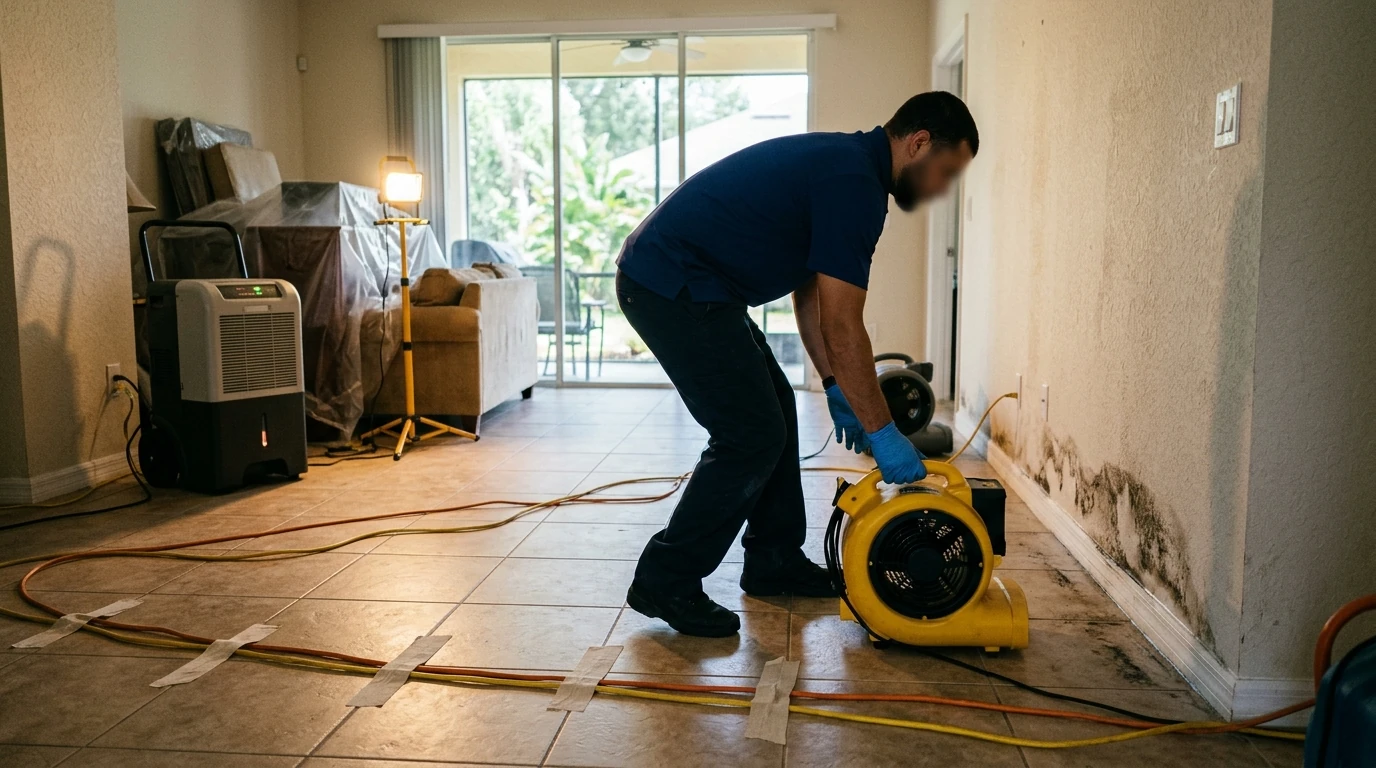
Extraction and drying, without any rebuild, typically runs $1,200 to $4,500 for a residential job in Jacksonville. This covers pulling standing water, setting air movers and dehumidifiers, and monitoring the structure with a moisture meter until it reads dry.
A small, single-room Category 1 loss (a water heater or supply line failure) sits at the low end, often $1,200 to $2,000, because the water is clean and the drying footprint is small. Larger or Category 2 losses, where appliance discharge or gray water has contaminated more material, run higher because more surfaces need antimicrobial treatment and more equipment stays on site longer, sometimes 3 to 5 days instead of 2 to 3.
How Much More Does Category 3 Cleanup Cost Than Category 2?
Category 3 (black water) cleanup typically costs 30-70% more than a comparable Category 2 job because contaminated porous materials get removed rather than dried in place. Category 3 water includes sewage, any backup from a drain or sewer line beyond the trap, and rising flood water, and it requires PPE, disposal of affected materials, and antimicrobial application that Category 2 jobs don’t always need.
Category 2 (gray water), like discharge from a washing machine or dishwasher, or groundwater seeping through a foundation under hydrostatic pressure, still needs sanitizing but allows more materials to be dried and kept rather than torn out. That difference in how much gets demolished is what separates a $4,000 Category 2 job from an $8,000-$12,000 Category 3 job of similar size.
How Much Does Ceiling and Drywall Repair Cost After Water Damage?
Ceiling and drywall repair after water damage usually runs $800 to $3,200 per affected room, depending on whether it’s a patch, a full ceiling tear-out, or a popcorn-texture ceiling that needs matching. A single water stain with intact drywall might only need cutting, replacing insulation, and repainting, closer to the low end.
If water sat long enough to sag the drywall or delaminate the paper facing, the whole section comes down, along with any wet insulation above it. Larger rebuilds that also involve flooring, trim, and cabinetry push total reconstruction costs toward the $15,000+ range referenced in the table above; this work typically falls under reconstruction by a general contractor rather than mitigation.
Does Homeowners Insurance Cover Water Damage Restoration in Florida?
Most Florida homeowners policies cover sudden, accidental water damage, like a burst pipe or a supply line that suddenly fails, but exclude gradual leaks, flood water, and most sewer or sump pump backups unless you’ve added a water backup endorsement. Flood from outside the home, including storm surge and rising water, requires a separate flood policy through the National Flood Insurance Program or a private flood carrier.
Florida adds a few state-specific wrinkles worth knowing before you file. Many Florida policies carry a separate, percentage-based hurricane deductible that applies during named storms, which is higher than your standard deductible and based on your dwelling coverage amount, not a flat dollar figure. The state has also tightened rules around assignment of benefits (AOB) in recent years, limiting how restoration and repair work can be billed directly to the insurer without the homeowner’s informed consent; the Florida Department of Financial Services’ consumer division is the place to check your rights before signing anything. For the general coverage rules that apply regardless of state, see Does Homeowners Insurance Cover Water Damage? and the Insurance Information Institute’s breakdown of covered perils. Documenting the damage with photos before cleanup starts, and keeping every receipt, protects the claim either way.
What Happens During a Water Damage Restoration Job?
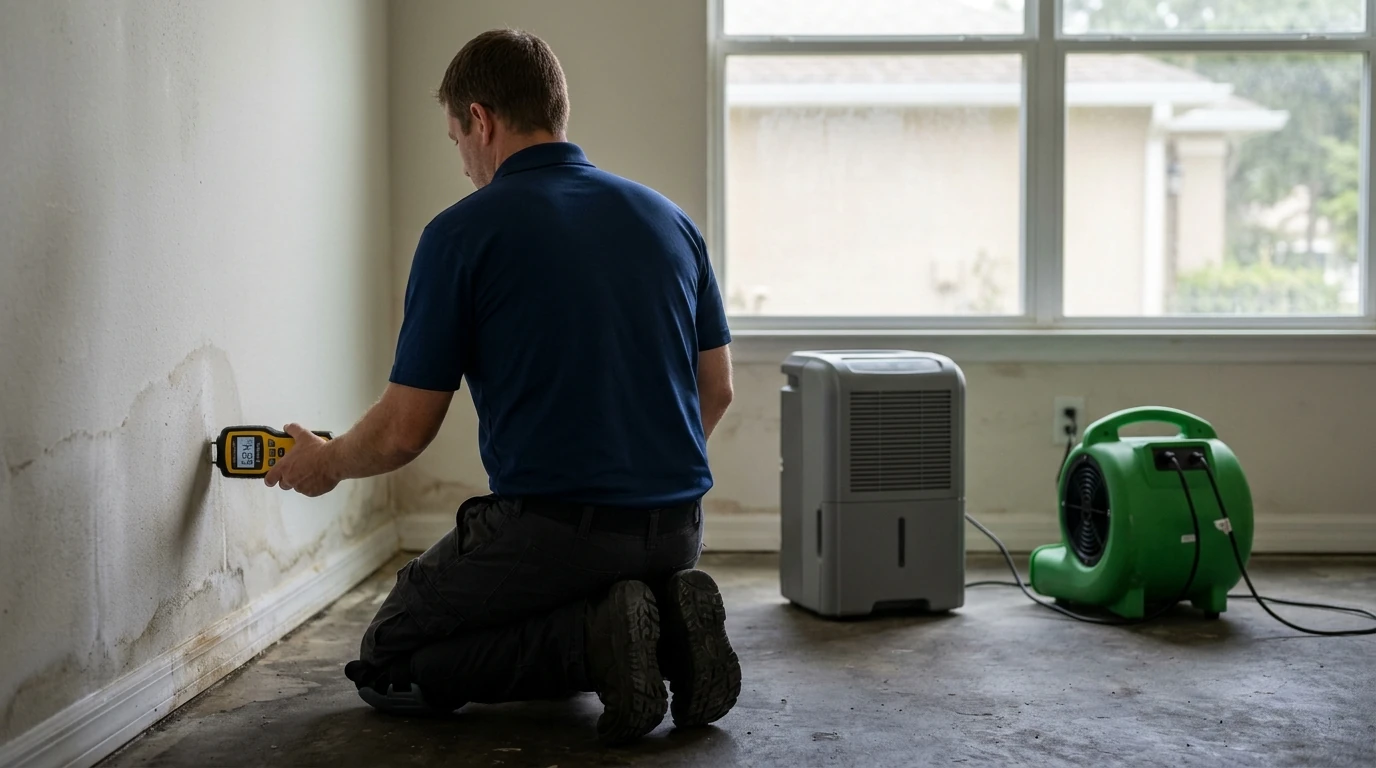
- Inspection and moisture mapping. A technician identifies the water’s category, maps how far it traveled under walls and flooring with a moisture meter, and writes a scope of work.
- Extraction. Standing water is pulled with truck-mounted or portable extractors, usually within the first visit.
- Structural drying. Air movers and dehumidifiers run until the structure reads dry, monitored daily and documented to the IICRC S500 standard.
- Antimicrobial treatment. Required for Category 2 and 3 water, applied to surfaces that stayed and any materials at risk of mold growth.
- Repair and rebuild. Drywall, flooring, trim, cabinetry or ceilings are replaced as needed by the contractor of your choice, once the structure is verified dry.
Getting a written scope before any of this starts is the single best way to avoid a cost surprise later, whether you’re paying out of pocket or through a claim.
A wet room in Jacksonville rarely stays a one-room problem for long, especially with the area’s humidity working against you. Request a water damage estimate before deciding whether to DIY it, and get the moisture readings in writing either way.
About American Quality Restoration
This guide was prepared with the American Quality Restoration team. American Quality Restoration employs IICRC-certified technicians (WRT, AMRT, FSRT, ASD) serving Jacksonville, FL and nearby communities including Jacksonville Beach, Orange Park, Ponte Vedra Beach, and Fleming Island since 2021, licensed in Florida under MRSR4374. Their crews handle water-damage-restoration, water cleanup, mold remediation, sewage cleanup, fire and storm damage across Northeast Florida, 24/7. Call American Quality Restoration at (904) 438-8780 to schedule a moisture assessment.